the feelings wheel, somatic balancing, and more
If you haven’t already been traumatized by “The Feelings Wheel,” buckle up and get ready. Counselors all over the world pull this bad boy out, asking clients to point and choose where they are and how they feel. This wheel (and others like it) have been printed on pillows and posters, and litter psychotherapy offices across the globe.
American psychologist Robert Plutchik developed his floral-looking “Wheel of Emotions” in 1980, and Gloria Willcox threw her hat in the ring with her own fully round wheel in 1982. Other folks have created their own version of the wheel since, including the uber feelings-inclusive big guy below.
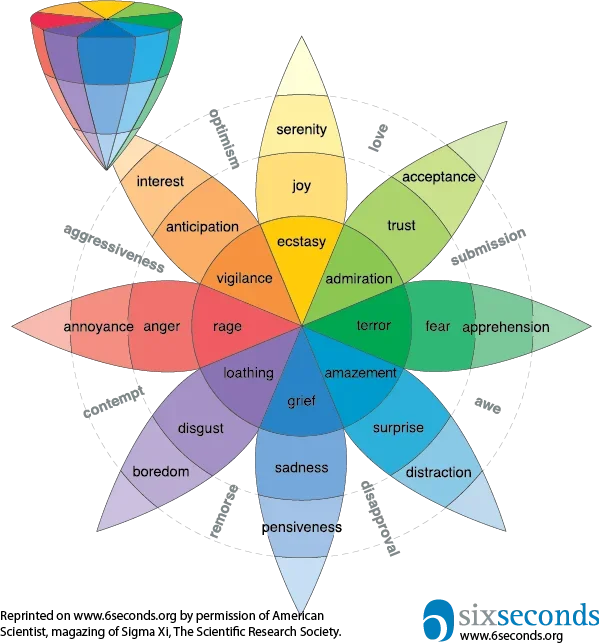
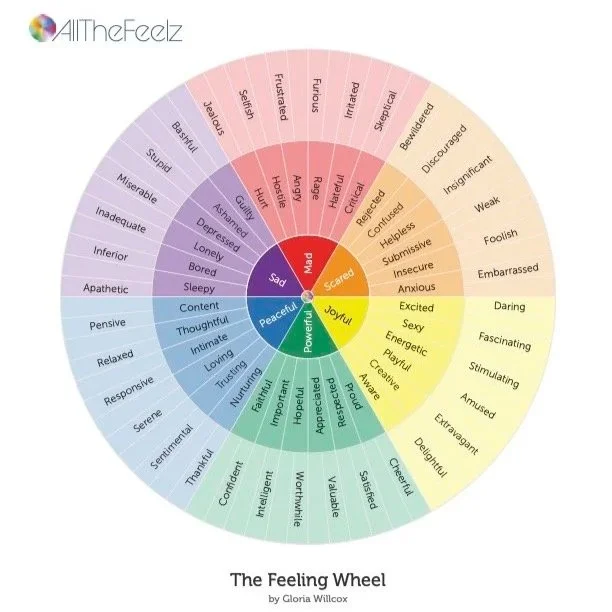
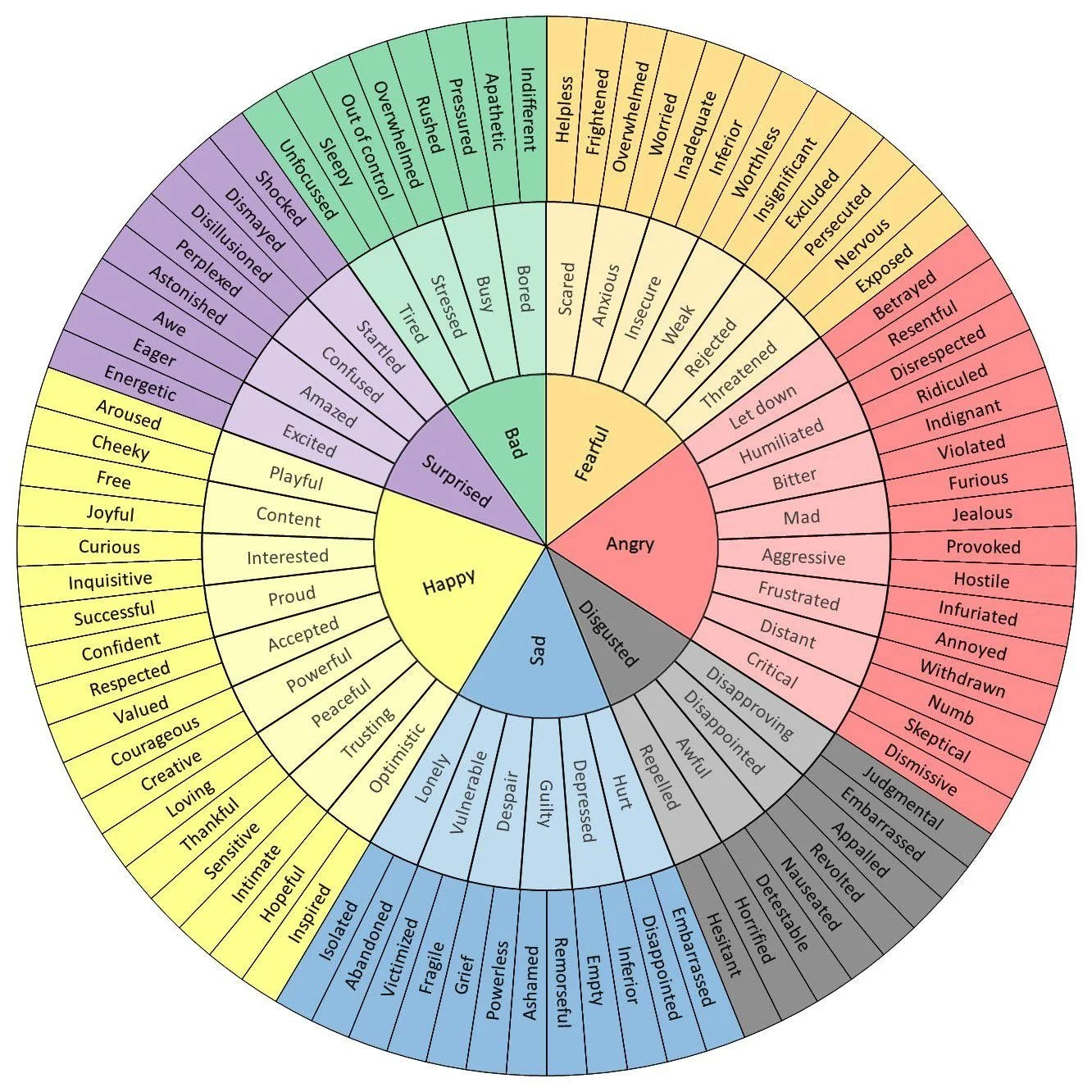
And yes, I use it and love it, too. Sorry! I can’t let y’all keep sitting in the all-too-convenient state that is calling yourselves “sad” or “happy” when I know we can do better. Er, We can go deeper. And isn’t that why you come to counseling in the first place?
I like to share that those inner wheel feelings — think: happy, sad, fearful, etc. — are protective feelings, and they serve a purpose. Think of them as the door we walk through to see what’s really going on. My goal as a guide, though, is to identify and process the connective feelings, i.e. the outer ring, more descriptive feelings on the wheel.
Think of it this way —
A client comes in and shares they’re really angry because they just found out they didn’t get a promotion at work. They’re red in the face, heart rate has been up all afternoon, they even snapped at their kids for no good reason about something unrelated because their fuse is so short. After 7 years of hard work at this company, they felt like a shoe in, and are furious that a newer, younger employee got the gig instead of them.
I hear this, and I think, “Wow, I would be angry too. Now what else is going on here,” and out comes the feelings wheel. The client considers it, moving from the red, inner “angry” section out to other options and lands on deeper feelings of betrayal, jealousy, and feeling resentful and disrespected. And wait, because come to find out the client also reveals some seated “fearful” sensations, including worry and worthlessness, as they wonder if they’ll be able to grow their family as planned, and if they’re fit to be a parent if they can’t even get freaking a job promotion seven years in.
While we can work with topical anger and fear, these deeper feelings illicit much more the client and assess and work through. Ultimately, too, the protective feelings get called out for what they are: the entry point route toward expressing, assessing, and processing everything underneath. That anger and fear is valid and its real, but the heart of what this client is feeling much more.
Okay, so maybe by now I’ve convinced the feelings wheel haters there is some merit to it. It can indeed be a useful reference point. Still, it falls a bit short of being truly useful in my opinion.
When I was in my first graduate studies program pursuing and MA in Yoga Studies, I chose to close out the program with a 96-page thesis focused on manipulated energetics of yoga applied to mental health to achieve a desired outcome, "or “Bio-individual Yoga Sequencing: Addressing Mental Health Imbalances (Anxiety, Depression) Through Energetic Balancing (Bṛṃhaṇa, Laṅghana) in Yoga Practice.” If anyone wants to read it, PLEASE let me know. It is harrowing to work so hard and be so proud of something that approximately 7 people have ever read. I digress.
Within this, I named a methodology I’d been using since 2016 with private clients, which I called the BIB Scale, or Bioindividual Balancing Scale. In my opinion, this scale takes the feelings wheel and makes it not only informational and introspective, but actionable. It also personalizes it, hence the use of the term “bioindividual.” One person’s anxiety may show up as isolating loneliness (-1), where another’s anxiety may present as restless overwhelm (+1) and thus it must be treated differently. Oppositely, in fact.
The BIB Scale asks a person to note where they are from -1 to +1, to note where they want to be, and offers tools and practices to get them there.
For example, say you are completely burnt out and feeling really lethargic. But you notice it’s 2PM and you’ve got a meeting to lead in 30m. You’re stuck in the office, wearing a suffocating business casual fit, and need to move from -1 lethargy and burnout to +1 enthusiastic and creative so you can properly lead and participate in this big meeting upcoming. Using the BIB Scale, and the accompanying guide graphic below, you can see that to move toward +1, you could try any of the following in your 30m window and office setting:
Elongate your inhales
A quick backbend in your office chair, or standing
A 2min Kapalbhati Pranayama practice
Listen to your favorite power anthem
Step into the sunlight and grab a quick power walk
Power pose in place
Find a group of gossiping coworkers and join in
Imagine your breath as light and take a feel deep, sunny belly breaths
Using the essence of the feelings wheel + actionable steps to move up, down, and all around the BIB Scale to achieve a desired effect is the name of the game, and puts a lot of control and power in your hands as the feeler. It goes beyond “How do you feel?” or “Where do you feel that in your body,” and further asks, “Now, what do you want to do about it?”
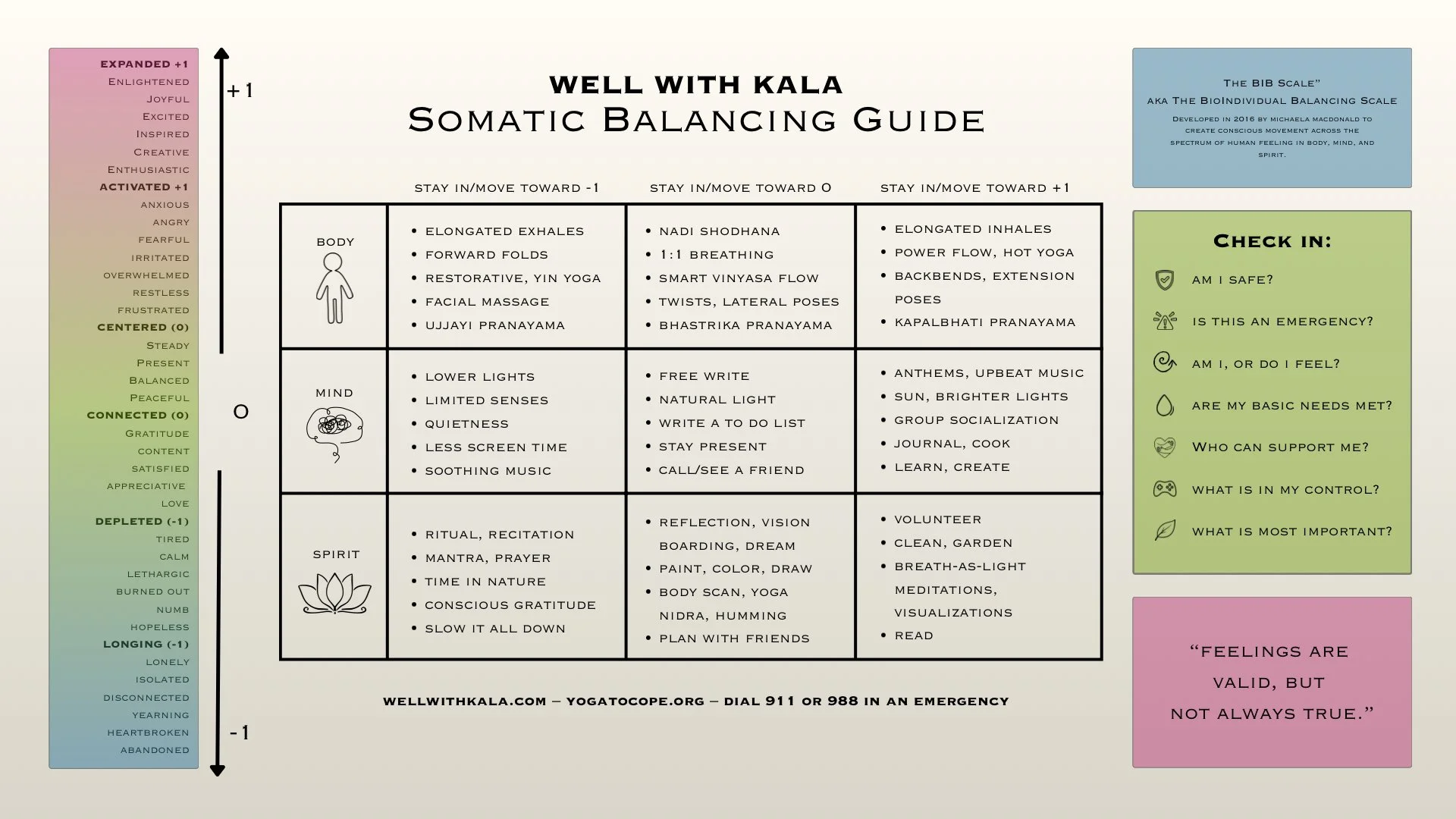
Let’s look at it another way, because it’s important to note that the stack of feelings over on the left there doesn’t necessarily correlate with better or worse, good or bad, positive or negative. While feeling inspired (+1) may seem like a great thing to feel, when that inspo hits at midnight and you have to be up for an early morning flight but the wheels are endlessly turning in your mind, it becomes a bit unwanted. Alternatively, feeling sleepy (-1) at night is ideal!
Clients come in with sleep disruption all the damn time. Next to depression, anxiety, stress, infidelity, feeling lost, fertility issues, burnout, etc., if “sleep issues” are on someone’s list, they’re a priority. This, because a lack of quality sleep makes everything else so much worse, and creates physical, mental, emotional, spiritual, and hormonal degrade slowly but surely.
So, using this scale, if someone is having troubling falling asleep (or wakes up and has trouble falling back to sleep) what can they do? In wake, we typically feel at a (0) or a (+1) state, and so need to move toward a (-1) sleepy state. And yes, a person can already be in a (-1) state, think: lonely, numb, hopeless, heartbroken, and simply need to go further and more deliberately into a (-1) state to find sleep. So, what do they do?
Checking the guide, someone trying to get to sleep could try:
Elongating their exhales
Forward folding
a Restorative yoga flow on YouTube
Facial massage, light, soft touch on their arms or legs
Keeping the space dark, quiet, and cool
Reducing sensory input i.e no incense or candles, eyes closed, no screens or devices making noises
Create and execute a bedtime ritual
Mantra recitation, simple breath meditation
When I was in the throes of my grief and loss after losing my younger brothers, I had already been attending yoga classes, specifically hot power yoga, for years. I went a few times a week to a local studio, and kept going after my losses. I didn’t understand from a zoomed out perspective why my grief was landing differently for me than it was for my family members. I wasn’t okay, surely not, but I was managing, and I felt a connectedness to the people I had lost, where my family members seemed totally disconnected, depressed, and overwhelmed, some turning to substance use or isolation for self-soothing. These, certainly very helpful coping mechanisms for people. I utilized alcohol in my own way, too, and isolated some as well. Still, I attended yoga classes just as before my losses, perhaps even more frequently, and I noted they left me feeling better than pre-class, and not just physically. I also recall noticing that yoga felt like a good way for me to access community without obligation to socialize per se. I could walk in, adhere to the “quiet studio” rules, cry and sweat and twist and breath with 15 or so other folks, and then simply leave. Not a word spoken, and yet I was free to be unraveled and wrung out there, just an arms length away from neighbors and strangers alike. I could be alone without being or feeling alone. More healing than I knew was happening in those sweaty studio classes, three times a week.
On realizing my intensive yoga practice may be influencing my grief, I pursued a teacher training in Bali and learned the science of yoga. And, indeed, the energetic effect of the type of yoga I was doing was directly countering the energetic effect of my grief. In math terms, the (+1) of my hot power yoga was counter to my (-1) grief, and so I tended to feel (0) states like love, gratitude, a deep presence and appreciation more than I steeped in anger or numbness. As well, as Dr. Lisa Miller supports in her book The Awakened Brain, a spiritual practice deeply, empirically has a positive effect on grief and depression. And I was living this, without knowing exactly how it was all working at the time. Knowing what I know now, combining scholarly yoga studies and clinical counseling work, I can say with full confidence this BIB Scale works if you work it.
It’s not like this guide creates a surefire way to move yourself from content to elated, or angry to calm, but it does give you some ideas that may help create a desired shift.
If you’re like “Where can I find body scans or yoga nidra practices to follow?” Fear not, because nonprofit organization Yoga to Cope has some starter resources available to you for free to download and try at your leisure. Explore their extensive resources and downloads available at www.yogatocope.org, and for anything they don’t cover, simply do some good old fashioned internet sleuthing to find the guides, teachers, and practices online that suit you!
Good luck, and please reach out with any questions, comments, or corrections. Our inbox is always open!