how to find a counselor: 101
If you’re reading this, welcome to your counseling journey!
Exploring counseling, especially as an adult, becomes a special and lowkey critical way to explore all the things elementary school and early caregivers doing their best didn’t quite get around to. Think: emotional recognition and regulation, skills for healthy conflict, pattern recognition, relational retroflection, self awareness and confidence building, crisis management, and so much more.
Yes, your best friends may be great landing pads for a good old fashioned gossip sesh, and some of them may even be downright motivational. Still, a counselor becomes a more targeted, non biased clinical space dedicated for you to explore, be challenged, grow, and get really, really fucking curious about who you are and how you show up in the world.
So, how do you find the right one for you?

First and foremost, while I’m saying therapy, psychotherapy, or counseling, I’m referring to the same thing. Once you move into psychiatry or psychology you’ve veered into differing careers and schooling, but for the most part folks tend to use therapy and counseling interchangeably and that’s just fine by me.
To become a therapist, counselor, psychotherapist (I’m just going to say counselor from now on, FYI, sue me) one must compete a graduate studies Master’s program, and then on graduating compete 3000 supervision direct and non-direct clinical hours under the guidance of a licensed professional. Only then may the person apply for licensure in their state of choice (or multiple states, one at a time), take an exam, pay a hefty fee, and ultimately be awarded their licensure. This means they’re able to work without being supervised by another professional, can go start their own private practice, and so forth. Those 3000 takes about 2.5-3 years to complete. So, all in all when you’re looking for a counselor, know that a fully licensed professional has completed a Bachelor’s program, Master’s program including a supervised clinical internship, and also has completed about 3 years of additional, professional supervised work under a limited permit. Thats a solid 9 year educational and professional journey, at minimum!
Does all that time and schooling mean every counselor is amazing at what they do, ethical, or even nice? No. Unfortunately you are still going to have to dig around to find your diamond in the rough as graduate programs and supervised settings frankly don’t do a good job of gatekeeping, which is another rant for another day.
When it comes to finding “the one” for you, the titles and abbreviations are absolutely ENDLESS and can become very confusing! The TLDR of it all is that all clinicians work within state boundaries. Some states, and even some university programs, have different names for the same/similar roles. For example, in NY state a licensed counselor may be called a LMHC (Licensed Mental Health Counselor) but in CA state they may be called a LPC (Licensed Professional Counselor).
Here is a quick cheatsheet so you know who is what-ish:
Therapist/Counselor: Completed graduate studies (MA or MS) plus 3000 supervised clinical hours, focuses on clients who are individuals, couples, and families/groups related to life changes, coping skills, emotional regulation, pattern recognition. Typical session is 45-55min and can be weekly, biweekly, or otherwise. Rates range from $0-400+/session depending on insurance vs. out of pocket averages.
Psychologist: Completed doctoral studies (PhD or PsyD) and may focus work more on clients’ behavioral patterns, clinical assessments and psychological testing. Typically there is an initial formal clinical assessment appointment, which can be 1-3 sessions total, 2-9 hours total, and can range from $300-$3500+ depending on insurance vs. out of pocket averages. Following assessment, regular weekly or biweekly sessions are 45-60min and average $150-500+ per session depending on insurance vs. out of pocket averages.
Psychiatrist: Completed medical doctoral studies (MD or DO) and can diagnose and prescribe/medicate patients. Typically there is an initial formal clinical assessment appointment, which is 60-90min and can range from $300-750+ depending on insurance vs. out of pocket averages. Following assessment, regular biweekly, monthly, or even quarterly sessions are 10-30min and average $150-400+ per session depending on insurance vs. out of pocket averages.
LMHC/LPC/LMFT/LCSW: Fully licensed clinical professional who completed graduate level studies and completed 3000 supervised clinical hours
AMHC/APC/-LP/AMFT/ACSW: Associate level graduated clinical professional working under a limited permit, completing their 3000 supervised clinical hours and pursuing licensure in a chosen state
MHC/MFT/CSW-I: Intern-level non-graduated clinical candidate, completing graduate degree requirements within Practicum or Internship coursework under the supervision of a licensed clinical counselor and university staff
LMFT = Licensed Marriage and Family Therapist
LMHC = Licensed Mental Health Counselor
LCSW = Licensed Clinical Social Worker
These professionals all completed similar programming, and can work with clients in very similar, overlapping methodologies. They each completed internship/associate requirements within and beyond graduate studies. A LMFT may have focused more on relational, family, and group dynamics where a LMHC may have primarily focused studies on individuals. Both of these counselor types may see individuals and/or familys/groups/couples, often in private practice settings. LCSW tend to work more in community mental health or therapeutic agencies, hospitals, and crisis centers, though can also work in private practice.
I always say that I think finding a counselor can be a lot like dating. There are a lot of fish in the sea, and each counselor has a unique personality, personal story, and theoretical orientation that may or may not gel with you. Typically counselors will offer a free or low-cost consultation, which could be anywhere from 5 to 15 minutes long. This is a good space to touch base, ask questions, compare schedules, and get a feel overall. Consults may be a video or a phone call, and typically do not take place in person. Read on for some questions you may want to ask a new counselor in that consult!

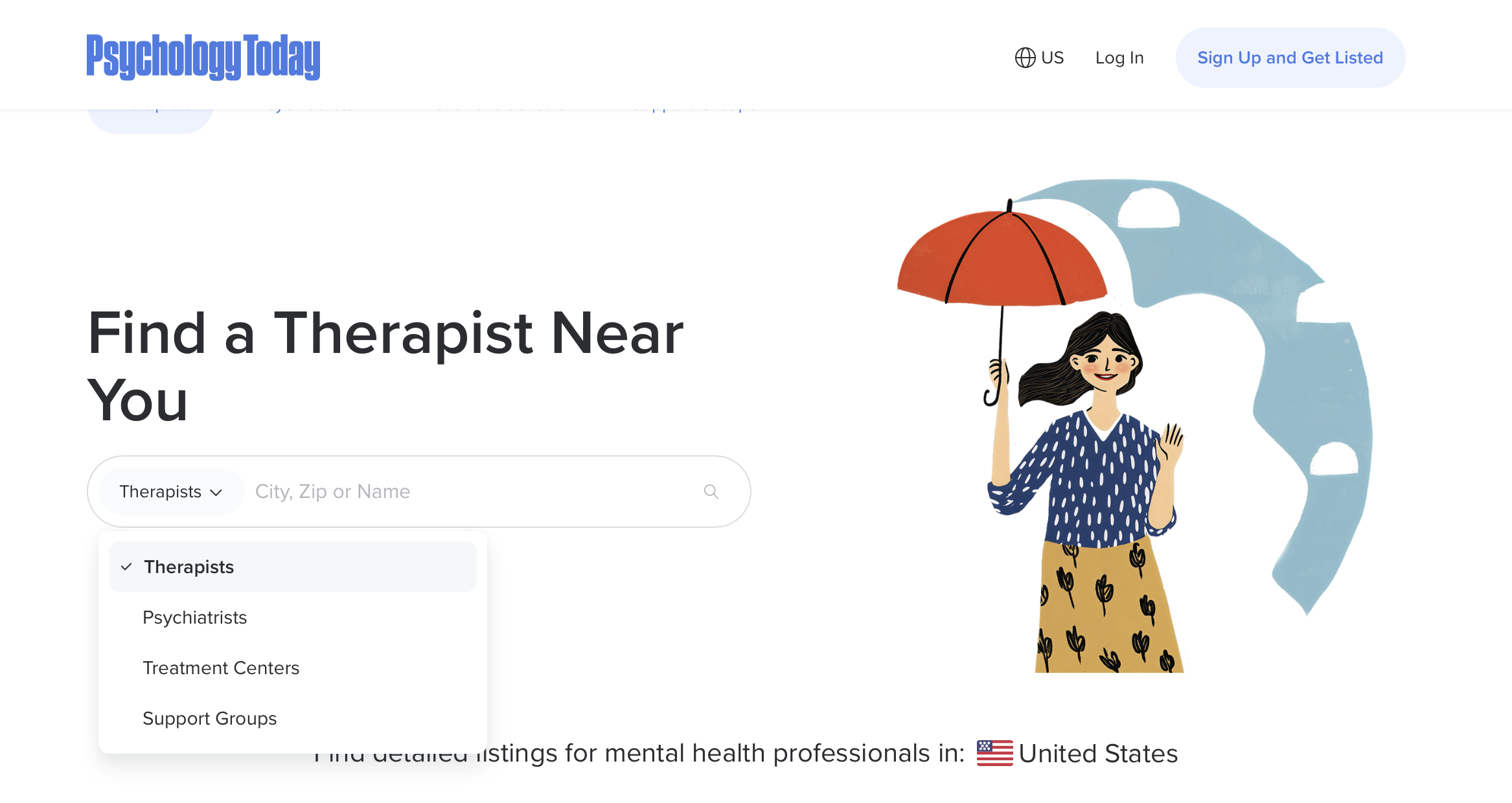
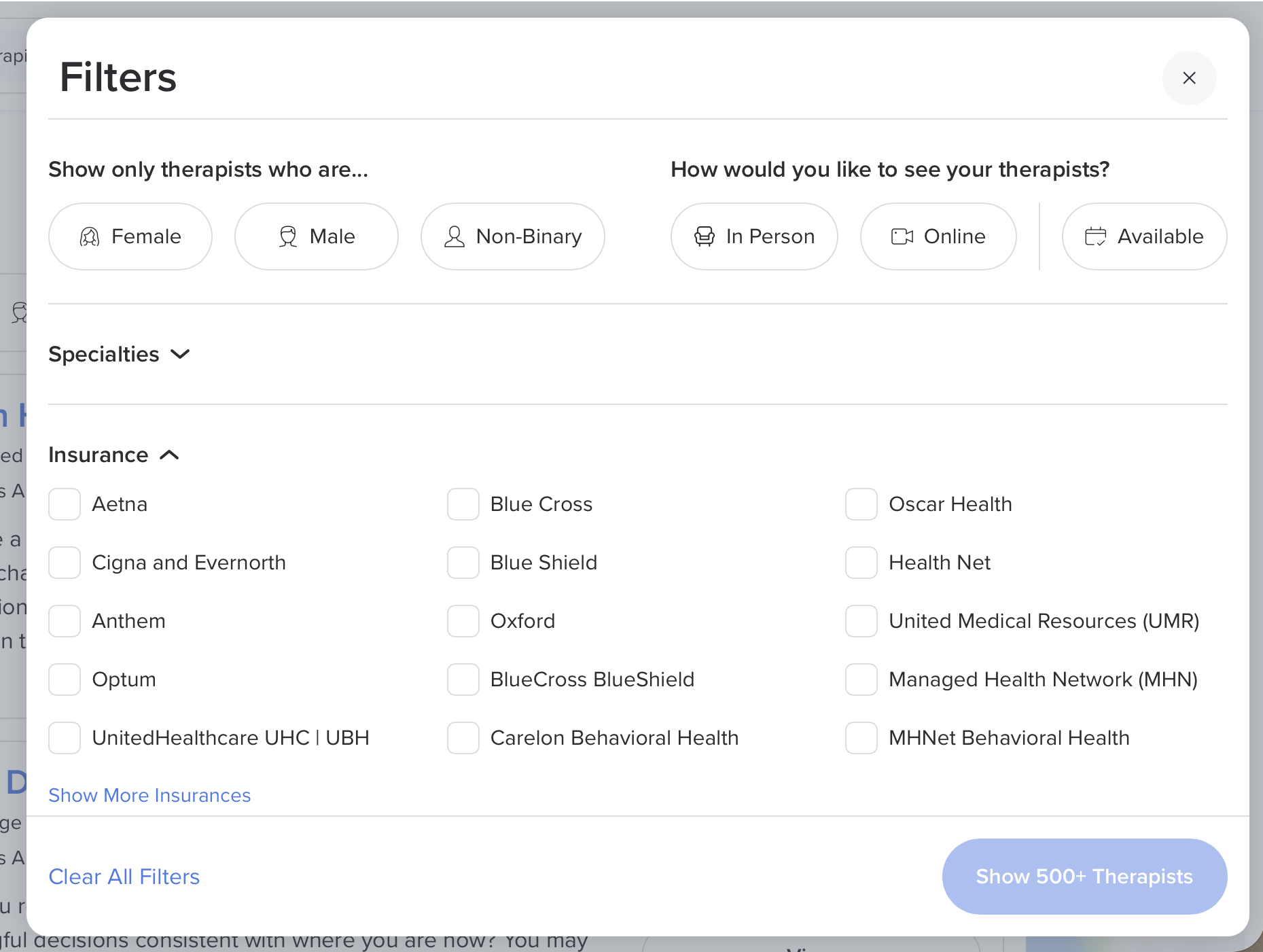
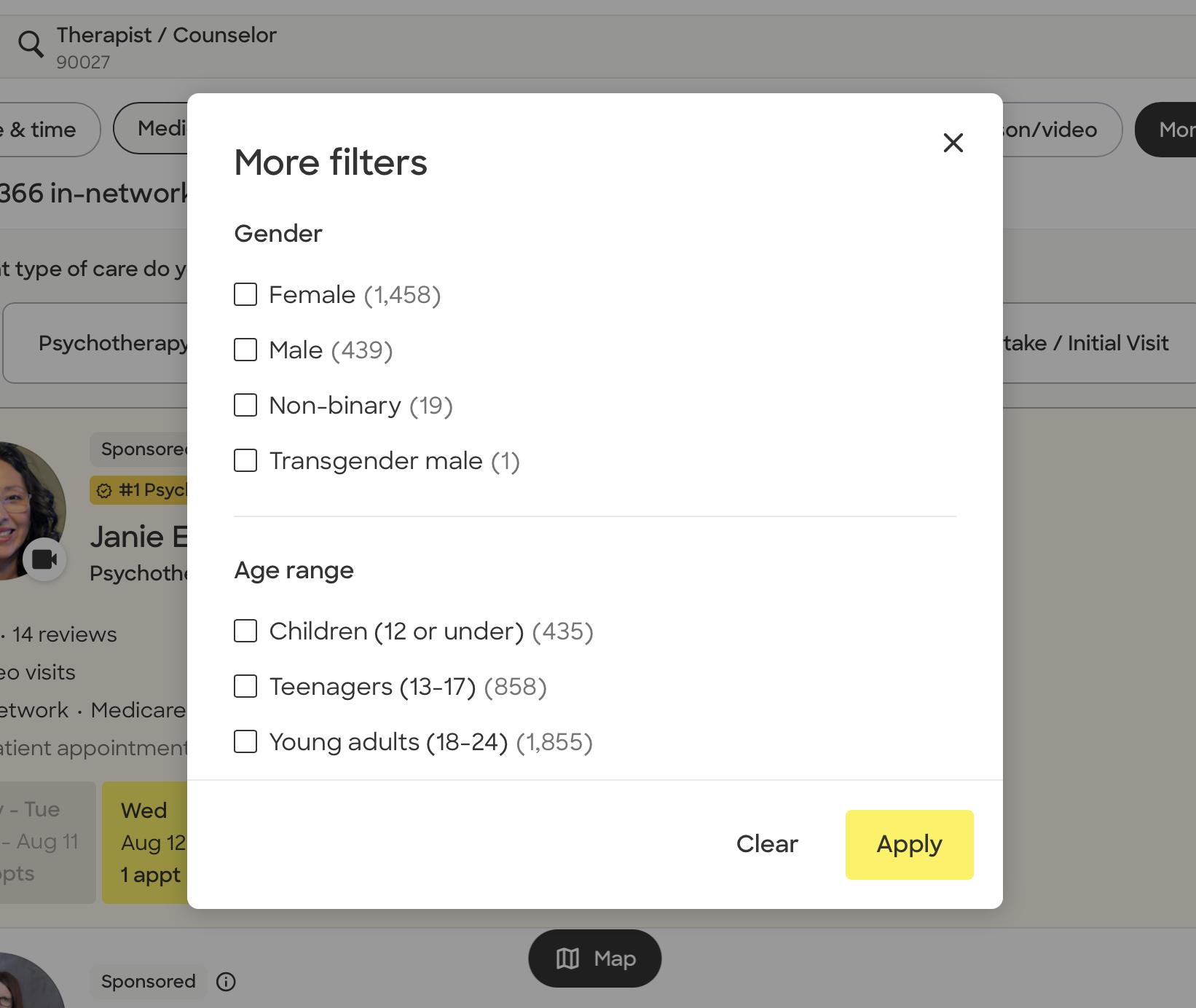
Beyond personality and chemistry, finances are obviously, typically a major factor. Utilizing web services like ZocDoc, Psychology Today, and your insurance website search feature are typically the best places to start your search if using insurance, as you can filter down to your insurance and specific plan. You can also filter for language, race, religion, specialties, location, session setting, and much more. See below for a glimpse into these services.
If you’re not utilizing insurance and are planning to pay out-of-pocket for services, you can also utilize ZocDoc and PsychologyToday, or can simply gather up some search terms and look for someone in your area. For example you might do an internet search for “Counselor 90027 existential stress anxiety” or “Psychiatrist perinatal care 90027 in person” — and then start shooting off emails to practices and professionals you find. Information gather, take advantage of free consult calls, and set your first appointment!

Questions to ask in a consult call with a new counselor:
What made you get into this work? Do you still feel passionate about it? Is this your first career, or are you a “second career counselor”?
What would you say is your “speciality,” or area(s) of interest when working with clients?
How do you/do you integrate [social justice advocacy, LGBTQIA+ advocacy, politics] into your counseling work with clients?
Have you worked with folks like me before, [Black women, trans folks, someone with disordered eating, post-rehab substance use recovery, child of immigrants, parents of newborns, second career seekers, children of narcissistic parents, etc.] and how has that been, what has been successful? What hasn’t worked?
Do our schedules align, i.e. “I’d like to be seen weekly, ideally a weeknight after 6PM, do you have that open on your calendar currently?”
Will I be able to see you [in person, virtually, both — think about what you’d prefer]
What are sessions like, how do you format the session time together?
How do you approach termination with clients, is there a plan in place from the beginning of our work together? How will we know it’s time for me to end treatment?
Remember, when pairing up with a new counselor, you want to mesh with them just a much as they want to mesh with you. This could be the formation of a multi-year long, deeply personal clinical relationship, so let this consult call be a two-way interview! You’re allowed to ask questions and will hopefully gather a lot of intel and a solid little vibe check from hearing your prospective counselor react and respond to you. Are they patient? Are they bullshitting you or do they seem genuine? Do they seem receptive to your questions? Are they also asking good questions? Do they seem distracted or present with you?
My overall advice for a consult call is: take up space, and listen to your gut. You can always do a few of these with a few different clinicians, and pick your favorite to move forward with.
Once you’ve completed a consult, and begun seeing a new counselor, my final bit of starter advice is this: give yourself the time to acclimate to the process.
If after a session or two you’re unsure about this new person, if they’re the right fit, or if counseling is the best spend of your time and money, I really want to encourage you to give yourself more time. The body, mind, and even spirit may resist whats new and unfamiliar at first, and it may feel weird - even bad - to dig into the darkest corners of self, to admit hard and harsh truths to a relative stranger, and to feel exposed and vulnerable in this new space. Let yourself. Let yourself feel exposed and weird and uncomfy and see where exposure to these new sensations can take you.
Give people a chance.
More to the point, give yourself a chance.
Enjoy the ride! Happy counseling —