what is a CBT Counselor and do I need one?

This piece is not about CBT counselors.
Yes, you’ve been click-baited.
The short answer is no, you do not need a CBT counselor, and may actually be better served by getting a bit more picky about who your counselor is and what practice style and theoretical framework(s) they’ve adopted. CBT counselors are a dime a dozen, but what does that even mean, and what else is out there?
As a student and young professional, clinical counselors are exposed to a number of modalities, theories, and frameworks that we are encouraged to explore and align with. For some, CBT is their bread and butter (I will rant about why that’s lame another day and time), and for others they take a more old-school, psychoanalytical approach. For many, an integrated approach is best, and frankly an integrated approach is most realistic. Picking ONE modality to follow for a whole career, and regardless of client, is a bit odd to me, you know?
For myself, it has always made more sense to choose a few modalities and theories that gel well together, and that can ebb and flow to meet the needs of the variety of clients who seek treatment. The framework I work within is indeed integrated, and feels both specialized and broad. A counselor’s elevator pitch of theoretical framework could look something like this:
Michaela is an AMHC clinical counselor combining yoga-based somatic practices and clinical counseling modalities to provide an accessible, therapeutic approach for clients. Her client work is rooted in psychodynamic relational, existential, and narrative theories via a trauma-informed, social justice lens.
Okay cute. Now what the hell does any of that mean? And how will that show up in the counseling work together?
Great questions, lets break it all down bit by bit:
AMHC clinical counselor: This would imply I am in my post-grad, pre-licensure 3000 hours*, working under a limited permit and being supervised by a fully licensed professional counselor. Lovely.
Yoga-based, somatic practices: I share in my bio that I previously competed a MA in Yoga Studies, and that I’ve been practicing yoga since 2008 and teaching since 2016. I also note the therapeutic impact yoga has had on me related to personal grief and loss, and that I share that impact with others toward their own health and healing. I note that “yoga” and “somatic” work is simply tapping, breathing, moving, and scanning, and that accessibility and usefulness is more important than flexibility or the ability to touch one’s toes. This inclusion implies I may introduce some breathing, movement, body scanning, meditation, pranayama, tapping, and so forth within the counseling work to further promote client success and wellness, with the client’s permission and interest established.
Clinical counseling modalities: This plural phrasing implies an integrated approach, i.e. multiple modalities from the counseling work being combined with the yoga/somatic work. Let’s further breakdown those I’ve highlighted:
Psychodynamic relational: Psychodynamic implies, in essence, that I believe the past informs and influences the present. Relational dynamics explore past and present relationships the client has experienced and their impact, fluid attachment styes, and counter/transference as tools. Overall, this implies I will be interested in early childhood caregiving dynamics, relative to how this client shows up in present romantic, platonic, and community relationships, and relationship with self.
Existential: This inclusion, especially paired with yogic roots, implies I may have a spiritually, energetically led foundation I work from that considers the “zoomed out” perspective, the person relative to the greater universe and human condition, and a focus on meaning making. Themes of purpose, death and mortality, containment vs. expansion, and universality may be explored. Why are we here and what are we doing with our time? How do we use these questions and answers to motivate forward and upward progress?
Narrative theory: This focuses greatly on a person’s individual story, how they tell it, and how that told story serves or doesn’t serve them. For example, shifting a personal narrative from victim to survivor, or including both. This framing notoriously focuses on the problem as the problem, and separates person from problem. My narrative approach is necessarily inclusive of story within society, and so considers oppressive, patriarchal, and limiting factors that affect oppressed and marginalized clients.
Trauma-informed: This, not only includes my own experience with trauma, but zooms out from personal story to how I can work with a trauma-informed lens with a client’s personal story. This means consciously establishing trust, consent, and boundaries and working within those. This lens also means exploring narrative and past with care, to avoid retraumatization and needless triggering. How can I explore your trauma without making you re-live it? When is the right time and place to go deeper, versus to retreat or pause? How can trauma be integrated in a way that is empowering and creates growth?
Social justice lens: This lens is crucial for anyone working with clients in the here-and-now in a responsible way, and being realistic about that. A social justice lens means I see the world for what it is, and has been, not as an “ideal future” that isn’t real, and do my best to understand my client’s position within that world. It means I acknowledge and integrate this honest and realistic worldview into my work with clients, who are often victims of power dynamics, systemic oppression, and sociopolitical injustices on a daily basis.
See below for a brief, non-comprehensive map of some different, popular theoretical frameworks/modalities to further explore how you might like to approach your work in counseling.
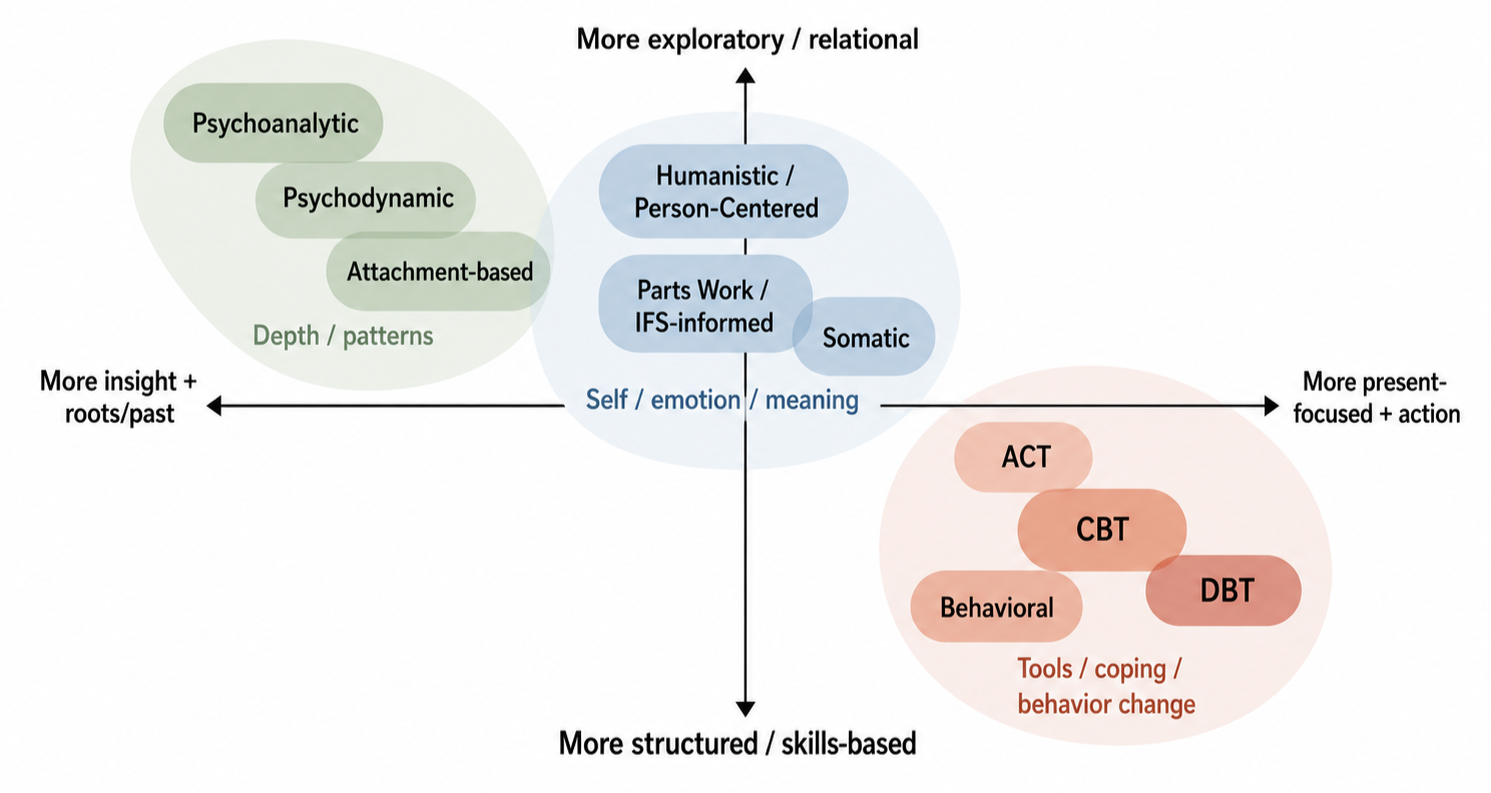
Remember: When looking for a counselor, you can ask during your consult call what their professional orientation is, and how it informs the work they do with clients. If you’ve never specified a type or style of counseling you might like, I highly recommend doing a little internet search to pair what you’re going through with what framework may be best for you to achieve success. A lot of these modalities are tested and proven to support certain mental health focal points. For example, DBT (Dialectical Behavior Therapy) is acclaimed for work with folks who are managing suicidal ideation/self harm or Borderline Personality Disorder. ERP (Exposure and Response Prevention) is acclaimed for work with folks managing symptoms of OCD.
The long and the short of modality hunting is this: If you got ten counselors who all promote CBT work, they’d still all approach CBT work with you in ten differing ways. This is simply a tool you can use to narrow your search as you try people on to see who fits you best.
Good luck!
*I will embark on my own AMHC post-grad, pre-licensure 300 hour journey beginning Fall 2026!